Australian Predators of Sheep

January 18, 2010

In one of the comments on the  Dohne Sheep in Australia post, Ceecee asked what other predators bother the sheep at the Homebush farm in Queensland, Australia. I asked Susan about Australian predators of sheep, and her husband was kind enough to send me more information. (Thanks Geoff!)

I’ve added a few extra facts since here in the U.S. we’re not familiar with how these predators became a problem in Australia. So here’s our combined effort, with quotes from Geoff in green:

“Homebush Sheep Predation”

“Feral animals which endanger our sheep are pigs, foxes, and previously domesticated dogs.”

Wild (feral) Pigs –

Feral Pig

Pigs are not a native species to Australia, but were introduced by way of Captain Cook with the first fleet to Australia in 1788.

These days the feral pigs are common and widely distributed over large expanses of Australia. They appear to threaten the long-term survival of a number of species of native plants and animals across Australia by either direct predation of native animals or by consumption of native plants.  They also have been implicated in the spread of the root-rot fungus Phytophthora cinnamomi.

And they are a problem when you have sheep!

“Feral pigs are endemic, and hard to control. They are omnivorous, and will eat nearly anything. They are very keen on young lambs. Large specimens have been observed trailing mobs and picking off lamb after lamb from the back of the mob. When killed and cut open they can be seen to have consumed many lambs in one ‘sitting’.”

Foxes –

Fox in Australia (by Joe Tompkins, from the Fox DNA website)

Foxes are feral in Australia because they’re another introduced species. European foxes were brought to Australia in the mid-1800s for hunting. They have spread to most of the continent since that time.   Foxes compete with Australian native animals for food and habitat and can act a source of disease.  They have a major impact on the Australian fauna, predating on ground nesting birds, mammals and reptiles. . . and sheep!

“Lambs are always at risk from all predators. Healthy adults are generally safe from crows, foxes and pigs. Sick adults or lambing ewes are also at risk from all predators, especially crows and foxes. A lambing ewe is a very vulnerable target. Foxes will kill a lamb before it has cleared the birth canal.”

Feral Dogs –

Wild dogs can be a problem anywhere it seems.

All classes of sheep are in danger of attack from dogs: wild, feral or domestic.  A dog, or much worse still, a pack of dogs, can inflict massive damage on a sheep flock.  The dogs will kill many in the mob by frenzied biting and tearing, while many other sheep die from being run to exhaustion, and will die with no signs of being bitten.  Others will survive the initial attack but develop infection. Unless these sheep are treated with an antibiotic many of them will die, or the wounds become a target for flies to lay their eggs in, which develop into maggots, and this also often leads to death.

Interestingly, after an attack it is possible to determine the type of dog which committed it. A dingo (native dog) will attack the flanks of the sheep, whereas feral or domestic dogs tend to attack the head and fore-parts.

I’ve known of many people here in the states losing sheep to dogs.  We’ve even had problems here, but fortunately, there’s never been more dogs at one time than our guard dogs could handle.

Now for the native species of Australian predators!

“Native animals which can attack our sheep are crows, eagles, and dingos.”

Crows –

Crow

Well, crows are familiar here in the US as well, but I don’t think I’ve heard of this problem before. . .

“Crows will attack a ewe in the process of lambing, targeting udder, vulva and eyes.  They will attack the lamb during birth or immediately after, before it stands, and peck out the eyes.”

Now that’s nasty!

Eagles –

Wedge Tailed Eagle (courtesy Wikipedia)

These are largest raptors in Australia and are the most common of all the world’s large eagles.  Wedge-tails can eat almost anything of a suitable size, live-caught or as carrion, so lambs are right in there as a viable food source.

“Wedge-tailed eagles will target and can carry away lambs, or tear them into carry size portions. They are Australia’s biggest eagle, and a protected species.”

And lastly, one of those uniquely Australian species…

Dingoes –

Dingos, along with feral dogs, are the biggest terrestrial predator in Australia.  As such, there are considered an “apex predator”, meaning they have no natural enemies of their own, and sit at the top of the food chain.

The attack sheep pretty much the same way as wild dogs, and are seen as a pest by the sheep industry in Australia.

Geoff also noted. . .

“Health of the sheep is a big factor in their vulnerability to attack from any predator, except dogs.  Vitality can be compromised by many factors such as available feed or parasite burden. Nutritional stress simply caused by a reduction in feed quality due to seasonal conditions will impact on the vitality of the sheep enough to make them more vulnerable to attack. Nutritionally depleted ewes have a longer and more difficult lambing, and the ewe and lamb are both slower to recover from the stresses of birth. From their and our point of view a quick birth is a good birth. Our management is highly focused on providing the pre-lambing ewes with added nutrition, especially in adverse seasons, to ensure they as strong as possible for the big event.

Some predation can be rationalized and come to terms with as ‘nature’s way’. When sick, weak, or dying animals are taken for example.  However it is hard to accept seeing the remnants of a mob that has been decimated and terrorized by a pack of dogs, or seeing an otherwise perfect lamb dying because it’s eyes were pecked out by a crow as it slept.

But we try.”

Sounds like an exceptionally good shepherd to me! Thanks for all the interesting info Geoff!

[affmage source=”ebay” results=”5″]australia[/affmage]

Hang On!

December 22, 2009

Sometimes in life, you just need to be like this Tufted Titmouse. . .

Take it to the wire, then. . .

Tufted Titmouse

And just hang on!

Friday’s Farm Fotos

December 18, 2009

Time once again for a look at miscellaneous pictures I took around the farm this past week.  This first picture is of Valrhona, one of our Shetland sheep ewes, bedded down in the dry grasses in the main pasture.

Valrhona, one of our Shetland sheep ewes.

The grass is maybe 6-8″ long, and seems to be just perfect for nestling down into it for extra warmth.  All of the 4-legged animals seem to think it’s great!

Once again, the animals are out in the main pasture:

Shetland sheep, Maremma, llama and doe goat.

I took this picture from inside the house, looking out the window in the dining area.  The sheep are in the shorter grass areas, grazing the green stuff tucked underneath.  Our Maremma sheep dog, Neffie, likes to stick close, but keeps to the highest vantage point she can find.

Still looking out the window, I saw one of our Buff Orpington hens.

Buff Orpington Hen

They love to scratch around in the leaves along the fenceline, looking for something tasty to eat.

One of the escapee roosters was doing the same thing around the base of a tree.

White rooster.

I sometimes throw crumbs out there, which they seem to enjoy.

The wild birds like the suet feeders.  Sometimes a Tufted Titmouse comes to visit.

Tufted Titmouse at suet feeder.

And sometimes these little birds show up in bunches.

Wild birds at suet feeder.

I’ve been trying to figure out what kind of birds these are, but can’t find anything that looks *exactly* like them.  The nearest I’ve come up with is an American Tree Sparrow.  But the colors aren’t quite right.

Here’s a couple getting a drink from the birdbath.

Wild birds at birdbath.

And one was sitting on the picket fence.

Wild bird sitting on fence.

So, anybody know what this bird is exactly?

Now, I know exactly what THIS bird is.

Immature Male Cardinal wild bird.

That’s an immature male cardinal with a punky ATTITUDE.

And I do mean, ATTITUDE.

Wild bird - immature male Cardinal.

I think his mohawk “hairdo” looked pretty cool.  Bet he thinks he’s a read macho dude!

Our farm collie, Toby, isn’t so much macho as goofy.  The minute we go outside, he runs around like an idiot trying to find a stick to carry.  It doesn’t matter if it’s toothpick sized or a log.

American Farm Collie, Toby.

Sometimes he gets sticks that are so big he can barely drag them around.

He and Neffie seem to enjoy grooming each other, each though they are both “fixed.”

Maremma sheepdog and American Farm Collie.

Later in the week I saw a Northern Mockingbird getting a drink from the birdbath.

Northern Mockingbird at Southern Birdbath.

Northern Mockingbird at Southern Birdbath.

The cardinals also visit the birdbath.

Male Cardinal

Male Cardinal

Sometimes even the chickens hop up for a drink from the birdbath, like this little Golden Sebright Bantam hen.

Golden Sebright Bantam Hen

Golden Sebright Bantam Hen

Glancing through all these pictures, you might get the idea things are pretty fowl around here.  From the looks of all these guineas following our male llama around, I’d say you’d be right.

Llama and guineas.

We’ve got all kinds of birdbrains outside and inside.   This one on the inside is hanging from the curtain on the back door. . .

Bye, bye!  See ya later!

Bye, bye! See ya later!

And bidding you GOOD-BY!

Male Cardinal On Cherry Laurel

December 7, 2009

We had some snow over the weekend.  Considering that doesn’t happen much these days, I went out and spent some time taking pictures.  Toby thought that was great, because it mean he got to go along and run around like a crazy dog.  Of course, my other “dog”, Spot (the cat), comes along too. 

It’s really kind of amusing.  My cat-dog stops at every tree to rub against it – you know how cats like to arch their back and rub against things?!

My other dog, Toby, likes to stop at every twig and tree, too.  But his modus operandi is to hike his leg and pee on it.  Sigh… gotta love ’em.

Anyway, I’ll sort through the pictures and put some up tomorrow.  I do have one I’ll put here though:

Male Cardinal Bird on Cherry Laurel tree.

This pretty male cardinal is perched on one of the cherry laurel trees along the edge of the front yard.

Now I must rush off!  I’ve got to get to town and see the eye doctor. I just called this morning to get the appointment.

EMERGENCY! MY GLASSES BROKE!

Yeah, I have an old pair, but one of the ear pieces is broken off and just a sharp piece of metal jutting out.  I taped that, so not too bad.

But the other problem is the lens on one side is cracked down through the middle. 

I really don’t need any help to have a cracked pot view of the world!

Visiting Panama City Beach And Pier

October 1, 2009

Panama City Beach – Day 2!


We were still getting rain our second full day at the beach, but the sky cleared off some that afternoon.

Gulf Of Mexico as seen from Panama City Beach, Florida.

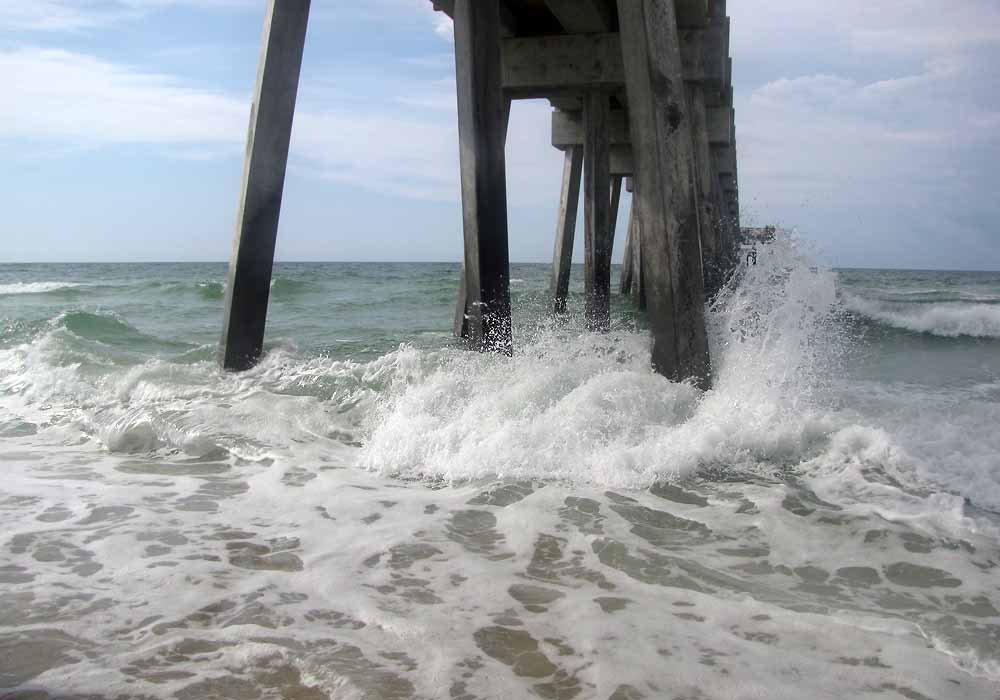
We decided to get out while the getting was good and walk along the beach.  We really stretched ourselves and walked clear down to the pier.  I rested under the pier while The Farmer walked on up to the gatehouse and asked how much it cost to go out on the pier.  Neither one of us had any money on us, so we decided we’d go back later in the afternoon.

Pier At Panama City Beach, Florida.

On the walk back to the condo, we saw a guy flying a neat kite.

Turtle Kite

At first I thought it was a Teenage Mutant Ninja Turtle kite, but I think it’s supposed to be a sea turtle.  Whatever kind of turtle it was, I liked it.

When we got back to the condo, we sat on the balcony and watched the scenery.  It looked like it might storm again, so there weren’t many people on the beach.  (And I think I heard The Farmer grumbling there were too many old people and not enough bikinis.)

This one couple was down under their bright umbrella, surrounded by birds.

Beach Birds

Of course, the gulls interest wasn’t so much in the people as the food the people were throwing out to them!

There were a lot of smaller birds munching on the sea oats down below our balcony.

Birds eating sea oats at Panama City Beach, Florida

The sky kept getting darker, and it started raining again.

Gulf of Mexico and pier at Panama City Beach, Florida.

When it cleared up a little, we went back to the pier and paid to walk out on it.  I could look down and see the barnacles and stuff clinging to the supports of the pier.

Pier support with barnacles.

But it was a looooong way down there, so the picture didn’t come out as well as I hoped.  The same was true of the little jellyfish we could see swimming by.

Jellyfish

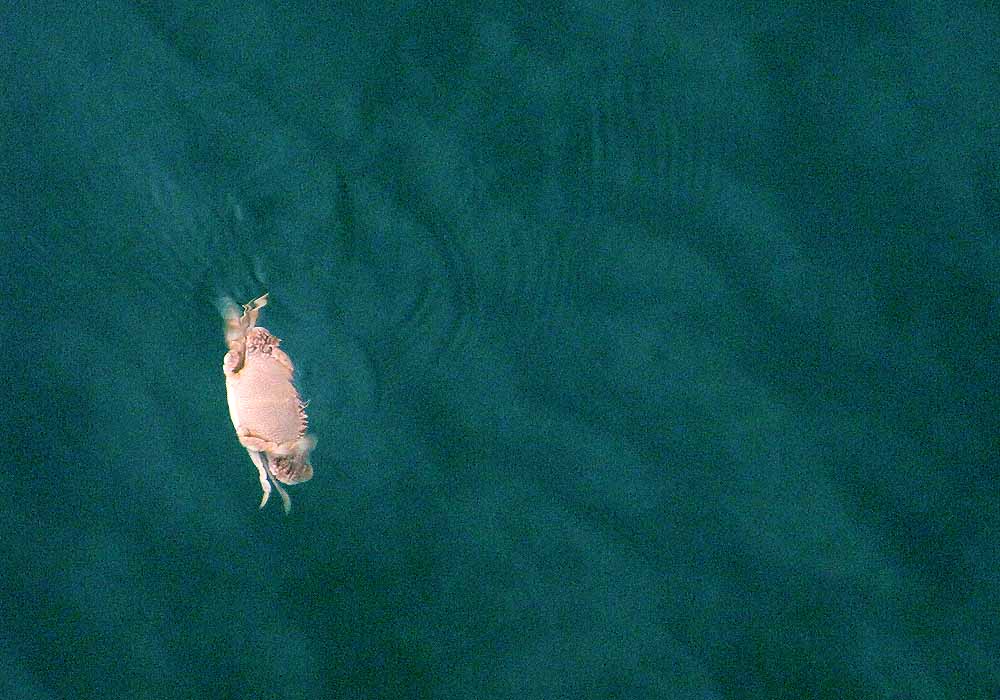
And once we even saw a crab swim by!

Crab swimming in the Gulf of Mexico at Panama City Beach, Florida.

I thought that was pretty cool, because I’ve never seen one swimming before.  The only time I’d ever seen crabs were scuttling around on the beach.

There were a lot of people fishing from the pier, but I only saw one person catch anything.

fish

I have no idea what kind of fish it is, but I suspect it was going to end up as bait for catching other fish.

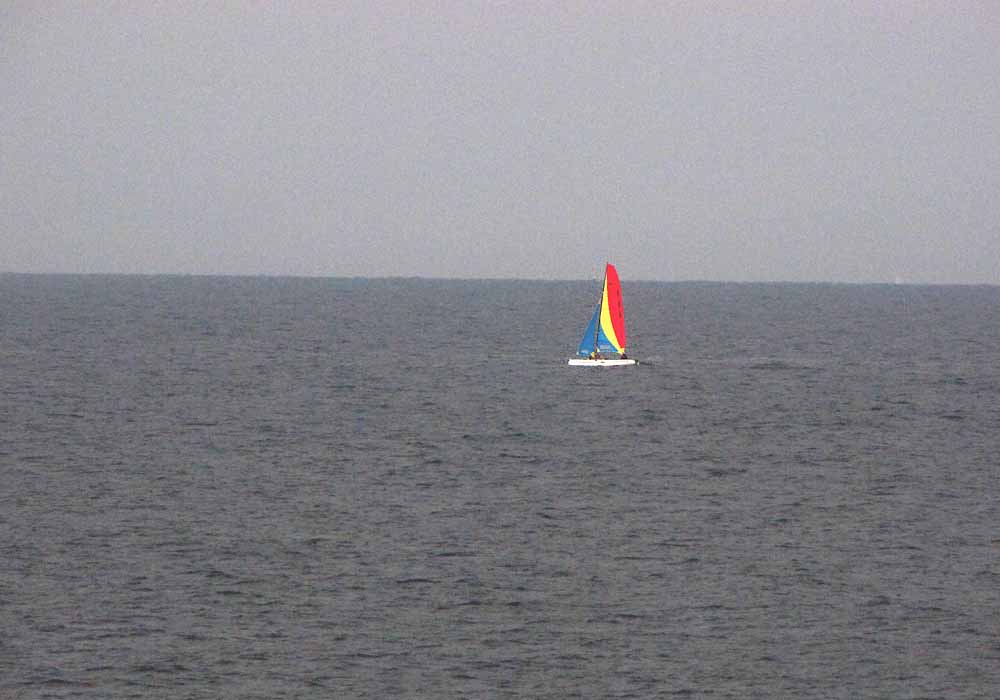
It started raining again, so we decided we’d seen enough, and after one last picture of a sailboat. . .

Sailboat on Gulf of Mexico in rainstorm.

. . . which looked bright and colorful out in all the grays of sky, rain and sea, we headed back to our home base.

1 … 3 4 5 6 7 … 9