Huddle of Guinea Fowl
It was rainy this weekend.
When that happens, sometimes the guineas get into a huddle. Usually while it is still raining, but sometimes they stay in a huddle after the sun comes out.
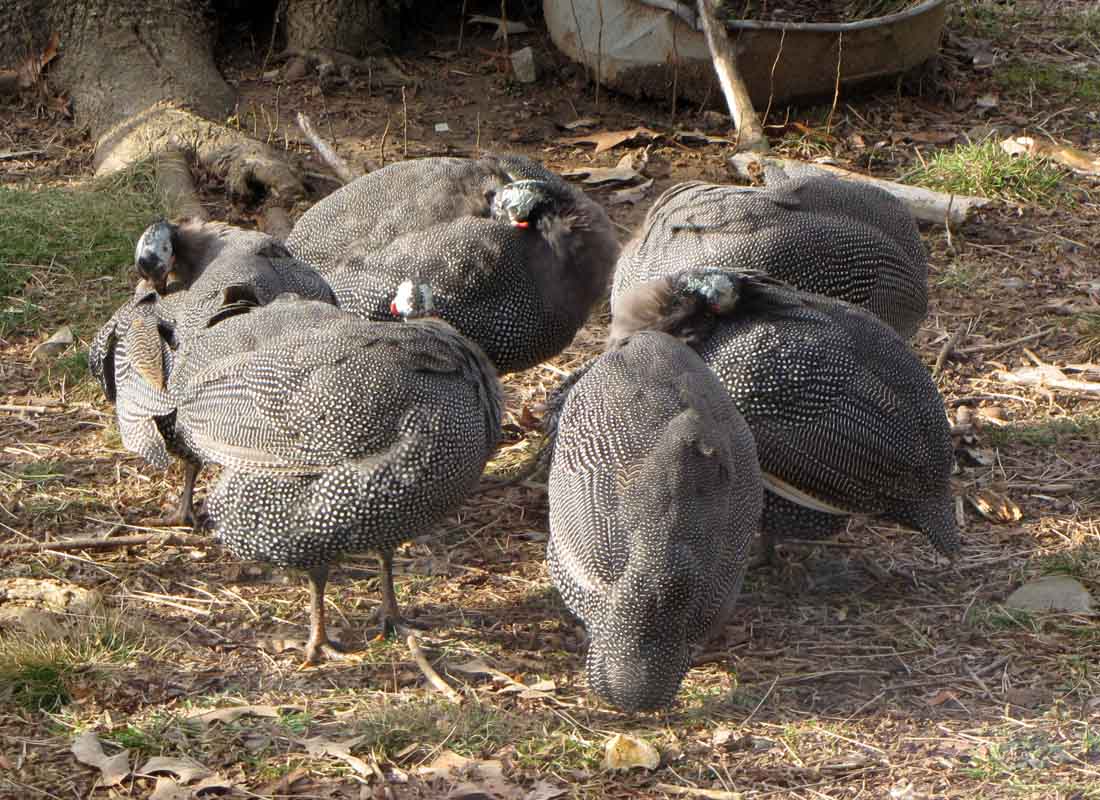
Looks like they’re having a Preening Fest.
Llama Bird Feeder Diner
So what in the world is a Llama Bird Feeder Diner?
Well, this week I looked out in the backyard and saw this:

Llama Bird Feeder Diner
Our male llama had discovered there were tasty treats in the bird feeder!
The other animals decided snacking from the bird feeder was a most excellent idea, so they wanted to get in on it.

The chickens got to enjoy some tasty treats because as Samson was eating from the bird feeder, he spilled some of the sunflower seeds and cracked corn onto the ground.
Our little goat, Cinnamon, and female llama, Keira, weren’t so lucky.

Samson shoved the little goat away from the feeder, and wouldn’t allow Keira to come near.
Keira hovered in the background, but Samson wasn’t sharing. The guineas got in on the action, and in the background made more actions of their own by chasing each other around and spooking Keira.
.
Llama Samson and the chickens and guinea fowl were all enjoying this extra treat. Keira was all forlorn because Samson wouldn’t share.

It's all MINE!!! You can't have any!
I finally had to go outside and chase them away from the feeder and out of the back yard. I put a bungee cord across the opening of the gate to keep them out. Most days it allows farm collie Toby and the chickens to go under the bungee cord and through the gate, but the llamas stay out.
Not this time.
I looked out later and saw Keira standing by the gate, looking wistfully at the bird feeder. I grabbed my camera, but before I could get it ready, she slipped UNDER the bungee cords!

Of course, there was no doubt if Keira made it, her partner in crime Cinnamon wouldn’t be far behind.

That didn’t mean she was going to get a share of the snacks however! Kiera wasn’t in the sharing mood either, and threatened to spit at our poor little goat when she tried to get near.
.
You will note that Keira one-upped Samson by learning to swing the feeder to shake more food down and out of the holes!
I let her enjoy her taboo treat for a while, then went outside where she could see me. That’s when she knew she was BUSTED!

Uh-oh, busted! I'm in big trouble now!
.
Yes, the criminal was charged with Breaking and Entering, and stealing sustenance from the birds!
<

LLAMA MUG SHOT
.
She has been remanded to my custody.
And though it confuses the chickens no end to have one of their routine pathways closed. . .

Chicken trying to get through gate.
. . . The gate has been slammed shut against further llama misadventures!
Another Rainy Day On The Farm . . .
Seems like we’ve been having a lot of rain lately. . .

Tufted Titmouse in the rain, waiting a turn at the feeders.
..
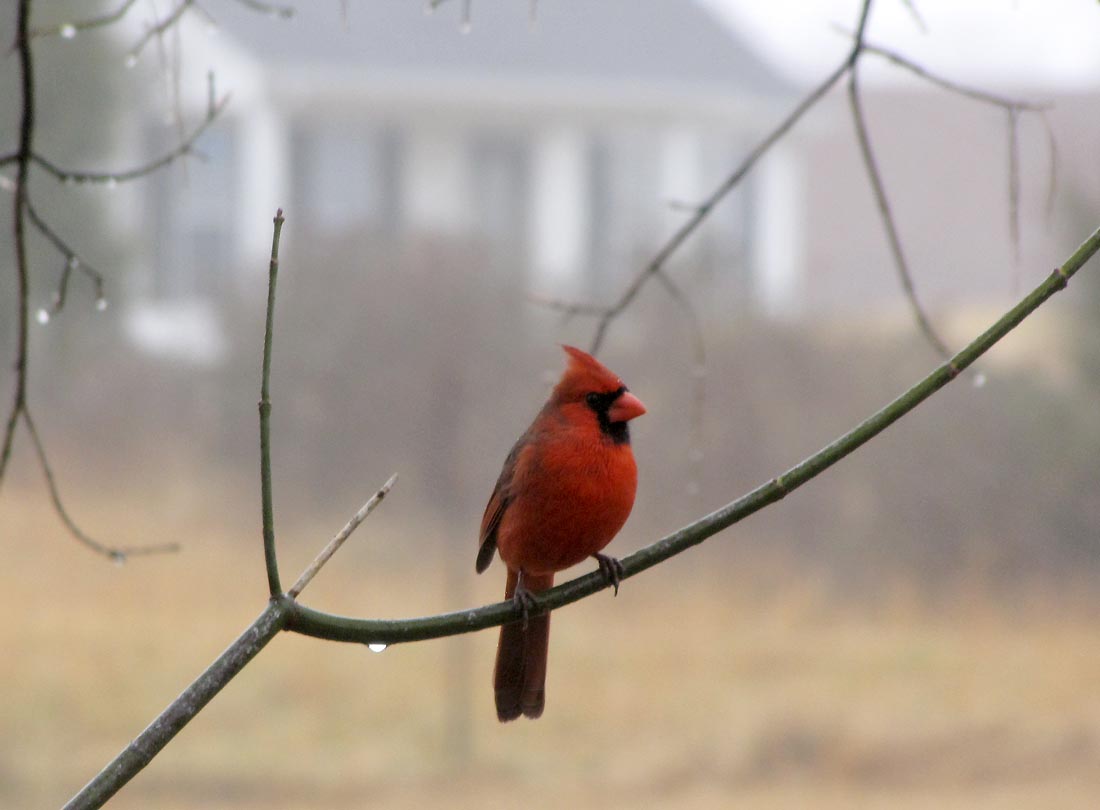
Cardinal on a branch.
. . .

House (or English) Sparrow eating sunflower seeds in the rain.
. . .
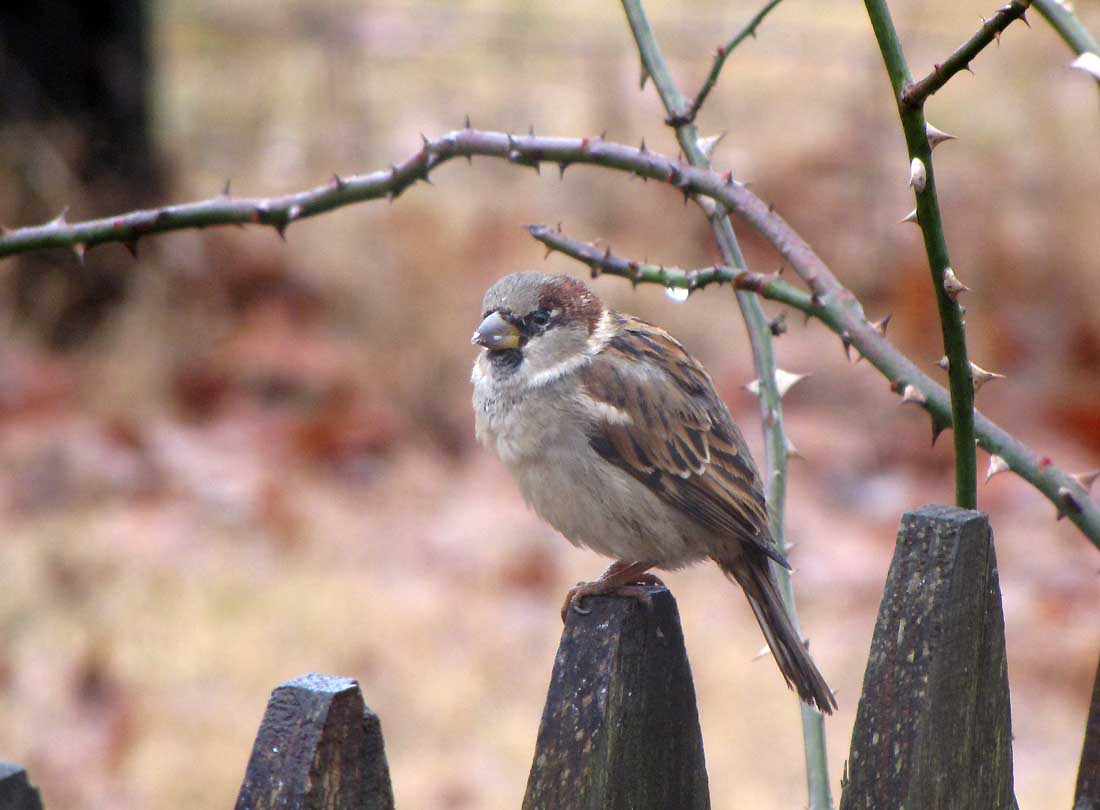
House Sparrow sitting on fence post waiting for a turn at the feeder.
. . .

Female cardinal at bird feeder.
. . .

Guineas sitting on a gate in the rain.
. . .
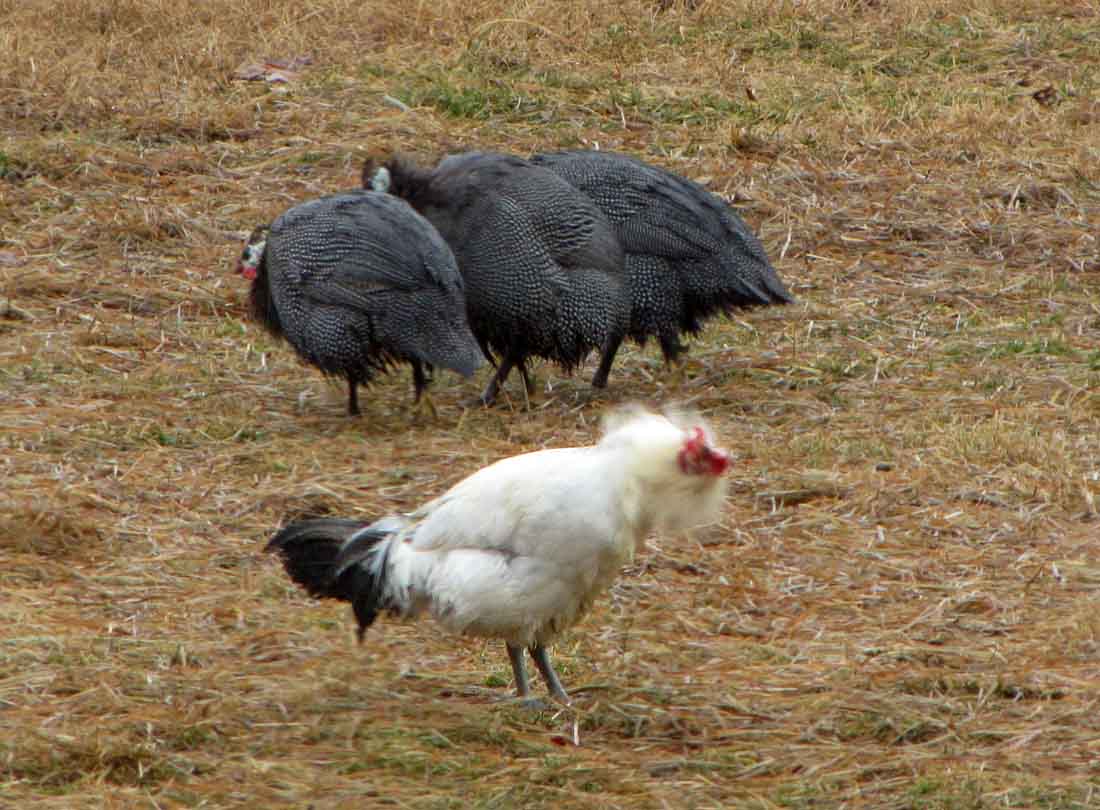
Rooster shaking rain off.
. . . I think it’s time for some sunshine!
Breakfast in Bed, LLama Style
I guess it’s not just cold weather that makes llamas opt for the lazy eating method. Here it’s warmed up considerably, and our male llama, Samson, still has a taste for breakfast in bed.
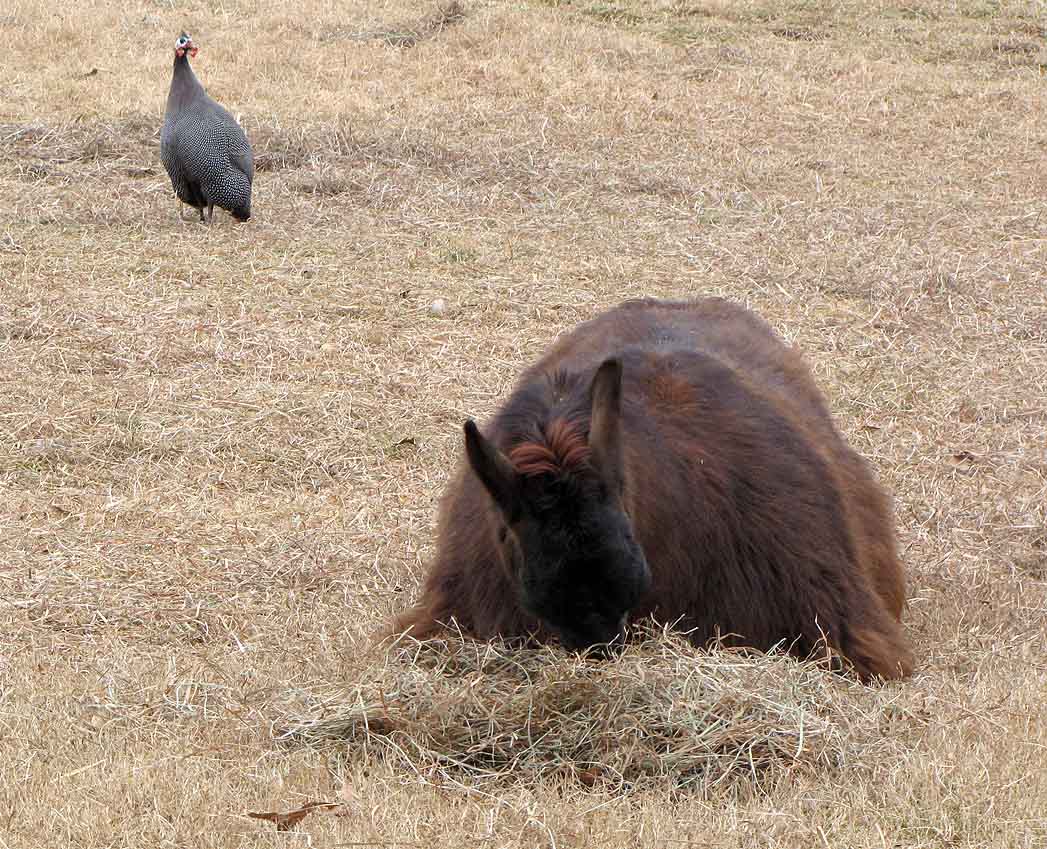
Lazy llama with his face buried in the hay.
Even the guinea looks like it’s thinking, “Man, is that one lazy llama!”
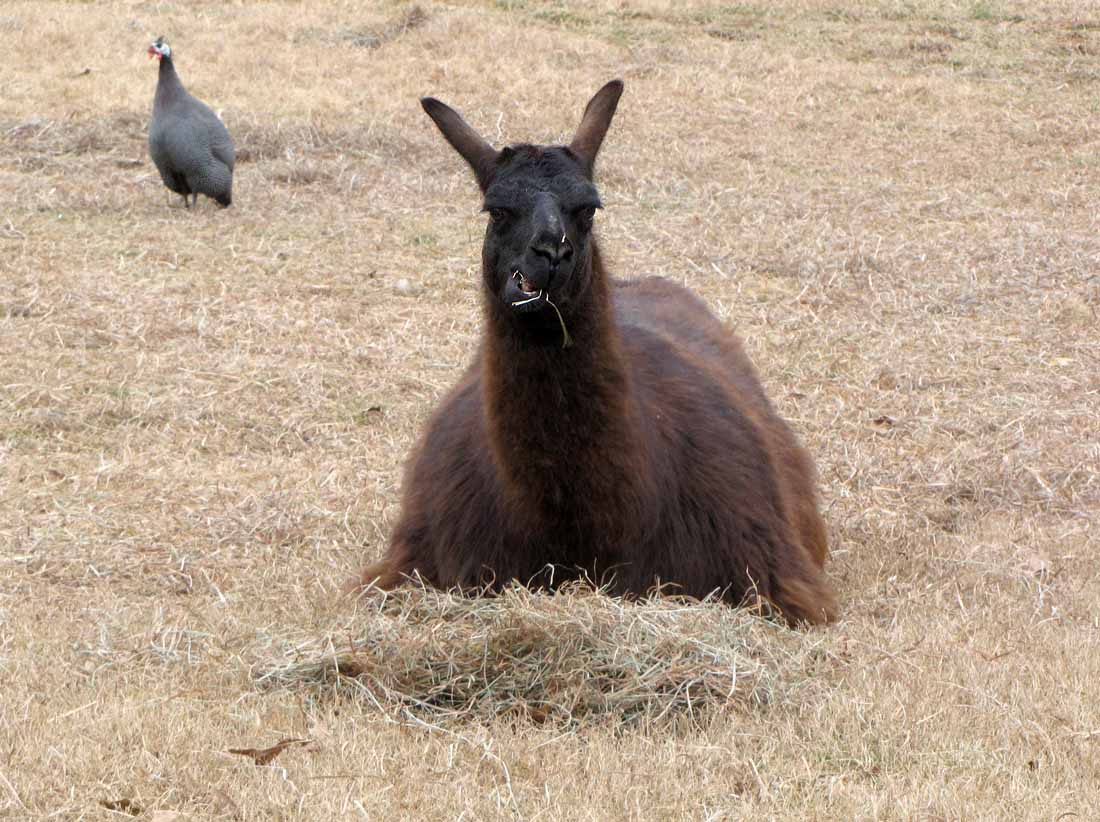
Eating while kushed.
He’s just munching away at that hay while the guinea shakes its head at his lazy eating habits, then goes back to grazing guinea style.
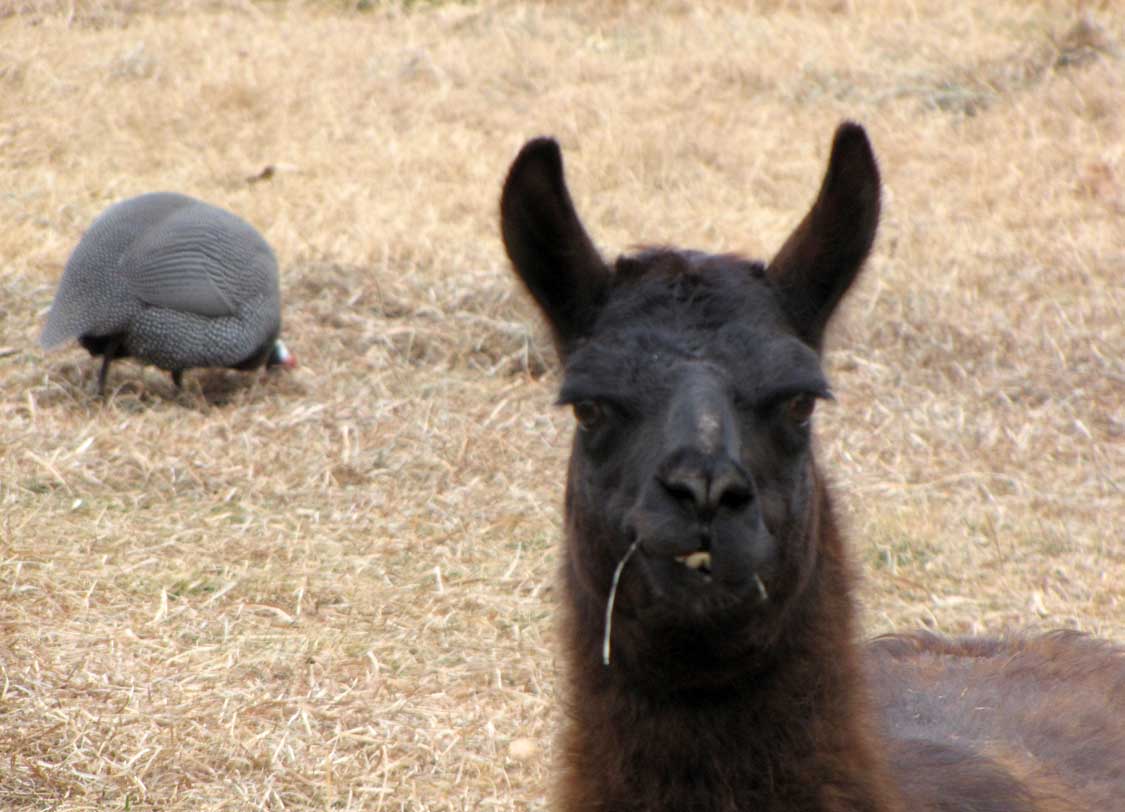
What??? You got a problem?
I guess Samson figures, “It works for me!”
Australian Predators of Sheep
In one of the comments on the Dohne Sheep in Australia post, Ceecee asked what other predators bother the sheep at the Homebush farm in Queensland, Australia. I asked Susan about Australian predators of sheep, and her husband was kind enough to send me more information. (Thanks Geoff!)
I’ve added a few extra facts since here in the U.S. we’re not familiar with how these predators became a problem in Australia. So here’s our combined effort, with quotes from Geoff in green:
“Homebush Sheep Predation”
“Feral animals which endanger our sheep are pigs, foxes, and previously domesticated dogs.”
Wild (feral) Pigs –

Feral Pig
Pigs are not a native species to Australia, but were introduced by way of Captain Cook with the first fleet to Australia in 1788.
These days the feral pigs are common and widely distributed over large expanses of Australia. They appear to threaten the long-term survival of a number of species of native plants and animals across Australia by either direct predation of native animals or by consumption of native plants. They also have been implicated in the spread of the root-rot fungus Phytophthora cinnamomi.
And they are a problem when you have sheep!
“Feral pigs are endemic, and hard to control. They are omnivorous, and will eat nearly anything. They are very keen on young lambs. Large specimens have been observed trailing mobs and picking off lamb after lamb from the back of the mob. When killed and cut open they can be seen to have consumed many lambs in one ‘sitting’.”
Foxes –

Fox in Australia (by Joe Tompkins, from the Fox DNA website)
Foxes are feral in Australia because they’re another introduced species. European foxes were brought to Australia in the mid-1800s for hunting. They have spread to most of the continent since that time. Foxes compete with Australian native animals for food and habitat and can act a source of disease. They have a major impact on the Australian fauna, predating on ground nesting birds, mammals and reptiles. . . and sheep!
“Lambs are always at risk from all predators. Healthy adults are generally safe from crows, foxes and pigs. Sick adults or lambing ewes are also at risk from all predators, especially crows and foxes. A lambing ewe is a very vulnerable target. Foxes will kill a lamb before it has cleared the birth canal.”
Feral Dogs –
Wild dogs can be a problem anywhere it seems.
All classes of sheep are in danger of attack from dogs: wild, feral or domestic. A dog, or much worse still, a pack of dogs, can inflict massive damage on a sheep flock. The dogs will kill many in the mob by frenzied biting and tearing, while many other sheep die from being run to exhaustion, and will die with no signs of being bitten. Others will survive the initial attack but develop infection. Unless these sheep are treated with an antibiotic many of them will die, or the wounds become a target for flies to lay their eggs in, which develop into maggots, and this also often leads to death.
Interestingly, after an attack it is possible to determine the type of dog which committed it. A dingo (native dog) will attack the flanks of the sheep, whereas feral or domestic dogs tend to attack the head and fore-parts.
I’ve known of many people here in the states losing sheep to dogs. We’ve even had problems here, but fortunately, there’s never been more dogs at one time than our guard dogs could handle.
Now for the native species of Australian predators!
“Native animals which can attack our sheep are crows, eagles, and dingos.”
Crows –

Crow
Well, crows are familiar here in the US as well, but I don’t think I’ve heard of this problem before. . .
“Crows will attack a ewe in the process of lambing, targeting udder, vulva and eyes. They will attack the lamb during birth or immediately after, before it stands, and peck out the eyes.”
Now that’s nasty!
Eagles –

Wedge Tailed Eagle (courtesy Wikipedia)
These are largest raptors in Australia and are the most common of all the world’s large eagles. Wedge-tails can eat almost anything of a suitable size, live-caught or as carrion, so lambs are right in there as a viable food source.
“Wedge-tailed eagles will target and can carry away lambs, or tear them into carry size portions. They are Australia’s biggest eagle, and a protected species.”
And lastly, one of those uniquely Australian species…
Dingoes –

Dingos, along with feral dogs, are the biggest terrestrial predator in Australia. As such, there are considered an “apex predator”, meaning they have no natural enemies of their own, and sit at the top of the food chain.
The attack sheep pretty much the same way as wild dogs, and are seen as a pest by the sheep industry in Australia.
Geoff also noted. . .
“Health of the sheep is a big factor in their vulnerability to attack from any predator, except dogs. Vitality can be compromised by many factors such as available feed or parasite burden. Nutritional stress simply caused by a reduction in feed quality due to seasonal conditions will impact on the vitality of the sheep enough to make them more vulnerable to attack. Nutritionally depleted ewes have a longer and more difficult lambing, and the ewe and lamb are both slower to recover from the stresses of birth. From their and our point of view a quick birth is a good birth. Our management is highly focused on providing the pre-lambing ewes with added nutrition, especially in adverse seasons, to ensure they as strong as possible for the big event.
Some predation can be rationalized and come to terms with as ‘nature’s way’. When sick, weak, or dying animals are taken for example. However it is hard to accept seeing the remnants of a mob that has been decimated and terrorized by a pack of dogs, or seeing an otherwise perfect lamb dying because it’s eyes were pecked out by a crow as it slept.
But we try.”
Sounds like an exceptionally good shepherd to me! Thanks for all the interesting info Geoff!
[affmage source=”ebay” results=”5″]australia[/affmage]