More Baby Chickens!
Yep, it’s still a chick, chick, here, and a chick, chick there!
These little guys are a few weeks old, but the mama hen has been keeping them in tall weeds in the goat and llamas pen. That’s actually a pretty smart way to keep them safe. The dogs patrol around there, and hawks and other flying predators can’t see them down in the dense weeds.
Peachicks And Histomoniasis
I’ve got some upset peahens and peachicks right now. I can’t say that I blame them. I ran around in the aviary this morning and scooped up all the chicks in a little crab net. (Somebody missed a chance for filming a winner for “Funniest Home Videos” I’m certain!)
I wish I could explain to the peahens WHY I took away their chicks. The little peachicks look healthy and seem to be doing fine with their mama peahens. But past experience has made it pretty plain that if I don’t segregate them, sometime between 6 and 14 weeks of age, the peachicks will get listless, and eventually just keel over and die.
Since the adults appear healthy, as do all the chickens and guineas, it took me a while to figure out what was going on. As the saying goes… you don’t know what you don’t know. And what I didn’t know about was a funky little protozoan parasite named Histomonas meleagridis.
To cut to the chase of the complicated dissertations I found in The Merck Vet Manual and other places, this punky little protozoa lives in a nematode (unsegmented worm) called Heterakis gallinarum that lives in the intestinal tracts of chickens, turkeys, and yes, peafowl. Some of the protozoa and eggs are excreted in the droppings, then when the birds eat anything nearby, they ingest the protozoa too.
It seems a large percentage of chickens harbor this worm, but it doesn’t seem to affect them so much. I don’t see little chicks keeling over. Same thing with guinea keets. (They’re more subject to predators and their stupid mothers leaving them behind when they can’t keep up.)
Not only are these protozoa hiding inside the poultry, they are also found in three different species of earthworms… and bet you see where that is headed. The fowl eat the earthworms, and if they didn’t have the protozoa before, well, now they do.
And if all that isn’t bad enough, the protozoa can be dormant in eggs in the ground for years. I haven’t found anything anywhere that gives any indication you can eradicate it.
So if once you ever figure out this protozoa is on your farm, you just might as well get used to dealing with it.
As it turns out, birds are most susceptible between 6 and 14 weeks of age to getting Histomoniasis, an infectious intestinal disease caused by the aforementioned protozoa. Their droppings become watery, they act sleepy all the time, and get weak. Eventually, most of them just fall over and die.
The common name for this disease is Blackhead, supposedly because sometimes the heads of affected birds turn black.
So how to treat this? Well, the Merck Vet Manual says:
“Nitroimidazoles such as ronidazole, ipronidazole, and dimetridazole are effective for treatment or prevention but are not available in the USA.”
Not very helpful, I’m thinking. The drugs are available in other countries, just not here. So the best you can do, near as I can figure out, is take heed of the advice to frequently worm birds to reduce exposure to the heterakid worms that carry the infection.
And if you’ve got peafowl, and I suspect turkeys from what I’ve read, you’d better separate the chicks from all the other birds, until they get past the danger period of 14 weeks old.
So that’s why our four little peachicks are now in a bird cage on the back porch:

Quarantine Headquarters!
The mama peahens are mad, and the peachicks are none too happy either… which is why I wish I could explain it’s quarantine or die!
Friday’s Four Fowl – Peafowl that is!
This morning another one of the peahens was out. I thought at first there was just one, but turns out she has two peachicks.

Two new chicks!
That brings the total babies out there to four. However, getting a picture of all four together proved to be somewhat of a challenge.

3 little peachicks, all in a row
I don’t like to get too close, because the hens are very protective and get upset. So here’s the best I could do at getting all 4 chicks in one picture.

4 peachicks!
There’s still one hen sitting on a nest, so maybe we’ll get one or two more!
Chickens In The Bird Bath
Our birdbath seems to be the community spa. Or perhaps it’s the equivalent of the local tavern. At the very least, it’s the local watering hole.
When I put it out in the yard, the idea was to give the wild birds a place to easily get a drink, especially in the winter. And they do use it, but they sometimes have to wait their turn. There might be a squirrel there, or the cat might be taking a sip.

"Ahhhh, the bouquet of bird-flavored wine... uh, water..."
Then of course, the wild birds larger and domesticated cousins frequent the bird bath too.

Just another couple out for a drink at the local tavern.
Sometimes it’s couples day, and other times, it’s just a hen party.

Just a couple of hens out for a drink.
I guess I disturbed their party, because the white hen left in a huff and a hurry.

"It's getting too crowded. I'm leaving!"
The other hen seemed unconcerned with my presence, but she didn’t want to be left alone either.

"Hey, where are you going???"
She finally decided she didn’t want to be left behind.

"Wait for me! I'm coming!"
Maybe now the wild birds can enjoy the birdbath in peace for a little while.
Fowl Sets of Two
Or maybe that’s two sets of fowl…
There are two pale gray keets running around out in the pastures now, besides the original “Chick-or-Keet.”

Two Gray Guinea Keets (and some siblings)
Strangely enough, the keets seem to shift parents. I mean, sometimes I’ll look out and see two gray keets with a group of guineas, and then another time they’ll be split up and following a different set of adult guinea fowl.
Only thing I can figure out is they are roosting close together at night, and when they take off in the morning, the same keets aren’t always following the same adults.
Then yesterday morning when I went inside the peafowl pen to put out some more food, two of the peahens were growling at me.
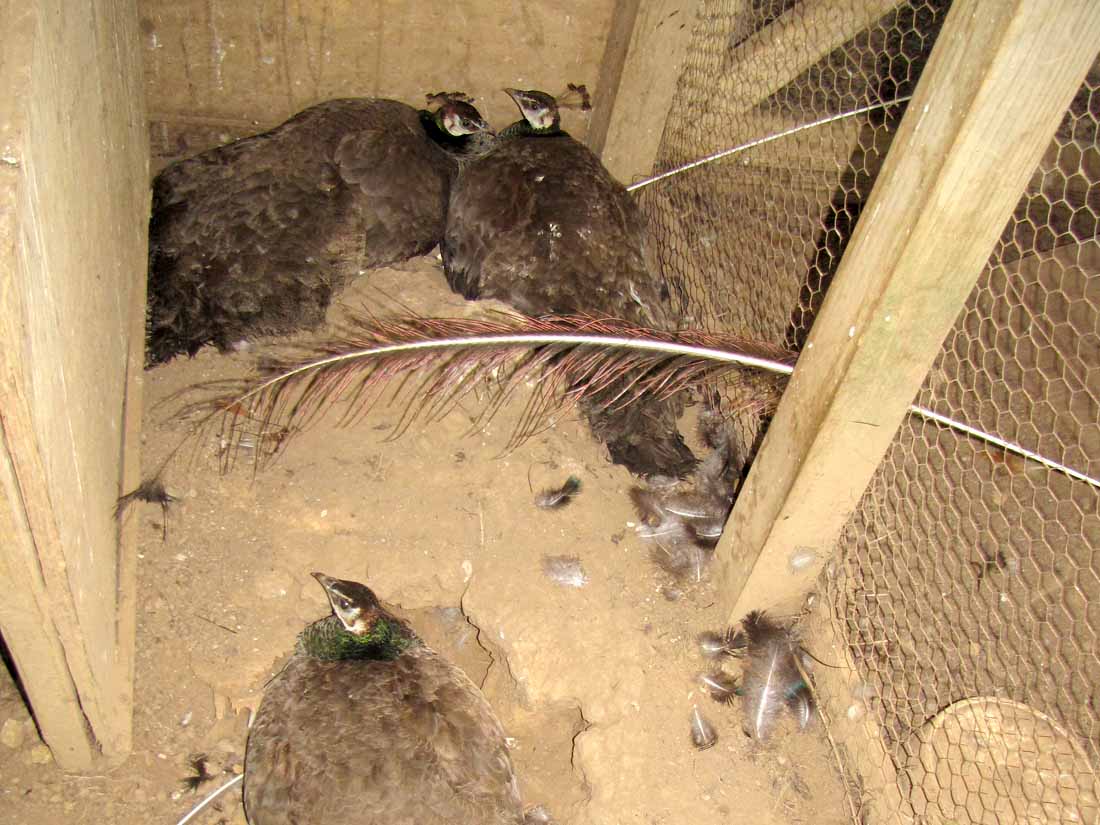
All four of peahens are sitting on eggs.
The two peahens in the back of the picture were the culprits. And since they only time I ever hear them growl is when they have chicks, I figured they must have at least one, even if I could see any.
However, later in the afternoon those two hens were out in the aviary, and sure enough, they had a chick.

Peahen checking on her peachicks
As a matter of fact, they have TWO chicks. . .

Cute little peachicks!
They scurry around after their mamas, but they also have an adventuresome streak.

Peachick Duet
I’ve noticed before that peachicks have a tendency to be more curious and range further from their mamas than the baby chickens, or even baby guinea fowl.
And I don’t feel so bad about not getting eggs to hatch in my incubator. I noticed there are half a dozen eggs still in the nest, though the peahens are still turning them, so I guess they aren’t done.
It should be interesting to see how many peachicks we get. I’ve never had ALL our peahens sitting on eggs before!