It looks like spring!
We’ve got some lovely weather this week, and true to the south, it’s even going to be rather hot later on! At least if the weatherman’s predictions are right!
There are still a lot of daffodils blooming in the flowerbeds. . .

Daffodils (Narcissus)
And some of the other spring flowers are starting to poke through the earth.

Prairie trillium (Trillium recurvatum)
There aren’t any blooms on the trillim yet, but they are popping up all over the woods.
There are also beds of Trout Lilies springing up. . .

Trout Lily ( Erythronium americanum)
But here again, it will be a little while before they are in bloom.
The dandelions are blooming here and there. . .

Dandelions (Taraxacum officinale) and violets (Viola papilionacea)
Some consider dandelions and wild violets to be weeds, but I rather like seeing them.
Even the honeybees are coming out to enjoy the sunshine and look for food.

Beeee-ware!
The perennials are starting to poke through the ground too, like these hosta plants and live-forever.

Hosta shoots
.
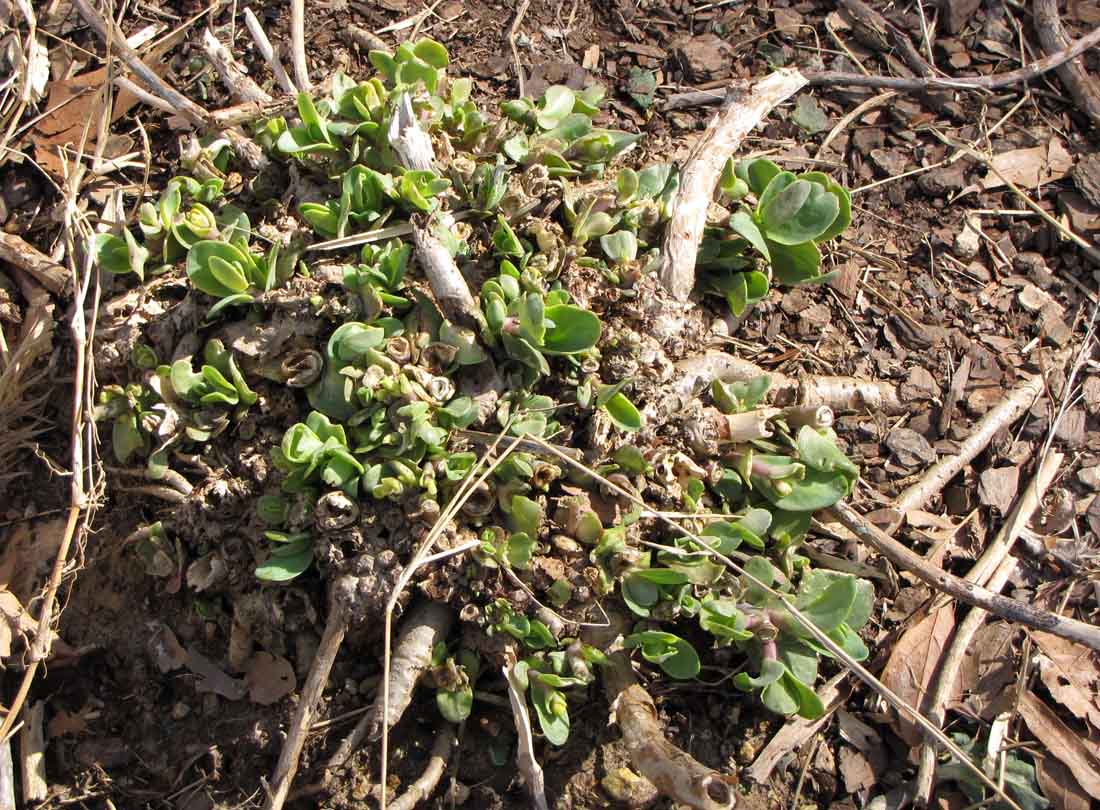
Sedum 'Matrona'
Whether it is good or bad, the pond is even showing green plant growth. . .
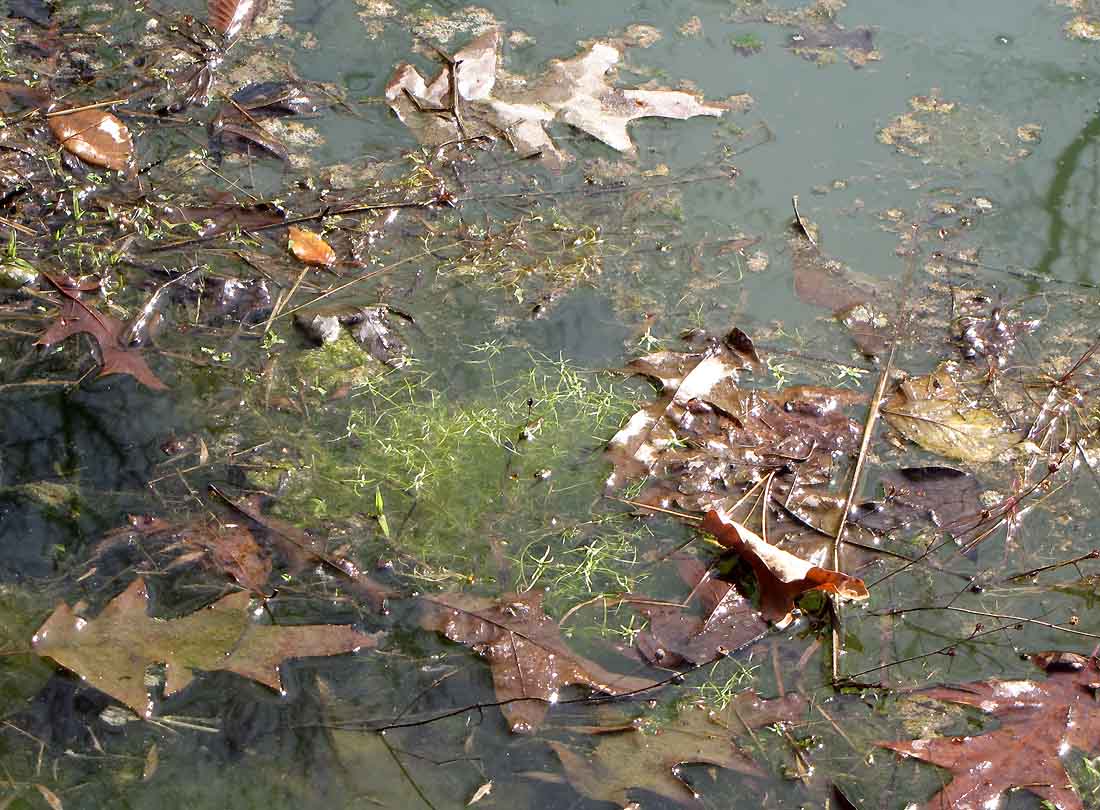
Pond with green plants growing.
This is one of the best parts of the year. Unfortunately, we don’t have what I’d call spring-like days – moderately warm – for long. Nope, it gets hot all too quickly.
But for now, it looks like spring!
Fowl Spring
It’s March and even when the weather doesn’t cooperate, the fowl – both wild and domestic, think it’s spring time.
I see wild birds out courting and building nests. A pair of bluebirds were rummaging around in the old garden area looking for nesting materials.

See anything you like?
One of the local cardinal girls tried to give them some advice.

"Are you looking for good building materials?"
Then one of the cardinal dudes decided to help them out.

"Okay kids, here's the best way to gather materials."
Evidently he was a little too pushy, because the female bluebird decided to just up and leave.

"That's it!..I've heard enough."
She eventually came back in time for one of the roosters to wander by and check out what they were doing.

"Well, they haven't got anything to crow about!"
And speaking of nothing to crow about. . . since the days are getting longer, another fowl fact is we’re starting to get more eggs. This morning I was making some scrambled eggs and used up the last two store-bought eggs. (EGG-LAND’S BEST! ALL NATURAL!)

Mass produced eggs are a pale imitation of REAL free range eggs.
Well, they may be Egg-land’s best, but those mass produced type of eggs don’t compare with our little farm’s truly free-ranging chicken eggs. Look at the difference in color between the store-bought eggs, and the rich color of an egg from one of our chickens.
Yep, those store eggs are just a pale imitation.
Are robins a sign of spring?
Yesterday it was snowy. I looked up in a tree and here’s what I saw:

American Robin in Winter
Yes, right there before my eyes was a robin. In winter. In the snow.
So I guess that must mean spring is coming, right? Cause after all, robins are a sign of spring, right?
Nope. Not right.
Although some robins do migrate, it’s more a matter of food availability than the weather. Food is usually more scarce in the winter. So some robins do migrate… but not all.
Instead they tend to gather in large flocks during colder months, going to large communal roosts at night. These flocks tend to stay in more rural areas where there is a better food supply. Or sheltered in woods. So although they may not be so readily seen in some places, especially in a more urban environment, there are still robins around.

Robin on snowy ground.
Robins aren’t that big on bird feeders for the most part either, being more prone to look for earthworms, insects, fruit and berries. They will occasionally turn up at feeders for fruit, but since they aren’t there a lot, that may be another reason people don’t realize they are still around.
People probably notice them more in spring because of the breeding dispersal, as the flock breaks up for pairs of robins to go to their own nesting territory. They are scattered into more places then, and people are also usually outside more to see them.
And of course, there ARE a few more robins, as the ones that DID migrate, come back to the area. But that doesn’t make robins a sign of spring, since there are some around all year long.
If you want a real sign of spring from the bird world, look for ducks or geese or any other true migratory bird that regularly migrates to and from your area to make an appearance. When they’re back in the area, ready for another nesting season, spring is on the way!
What Happened To Spring?
The skies are a dreary gray, and it’s in the 50’s. So what happened to our nice spring weather?
Still, I know it must be springtime, because all those wonderful spring flowers are blooming. I saw some bluebells earlier this month.

I’ve never seen any in our woods here, but I planted some in one of our shady flowerbeds. They’re properly called Mertensia virginica, or Virginia Bluebells.
Not far from them, the Solomon’s Seal (Polygonatum commutatum) started blooming a couple of weeks later.

They’re still going strong, although the Bluebells have pretty much died off.
However, the Lenten Rose (Helleborus Royal Heritage Strain) is still blooming like crazy.

It blooms for a long time!
And I know it must be spring, because the dogwood trees in the woods are blooming, and the little ones in our front yard have a few blooms, too.

We have a white one and this red one, a Cherokee Chief variety.
In the front flower beds, there are azaleas budding out, clematis starting to grow, plus “wild” geraniums, iris and beebalm. There’s also a little white flower formally known as Anemone pulsatilla, but also known as Pasque Flower, Wind Flower, Meadow Anemone, Passe Flower and Easter Flower.

I can understand why it’s called Easter Flower since in bloomed at just the right time for Easter.
The Bugleweed (Ajuga reptans) is also full of blooms, with one of the many hostas growing up through it.
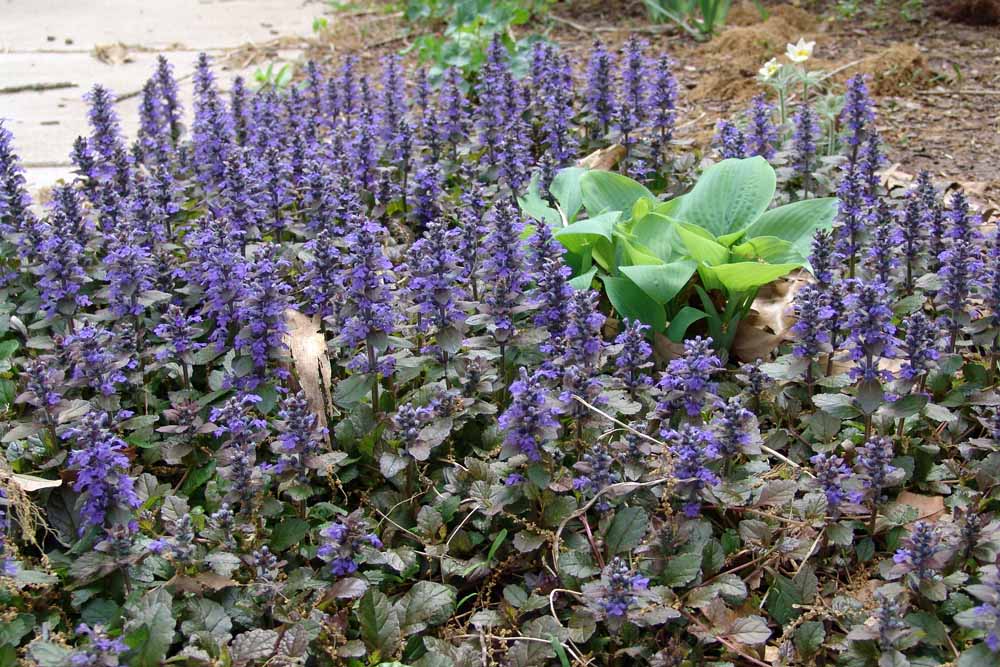
Of course, this is a just a smattering of the flowers blooming around here. It’s one thing I’ve had a hard time getting used to living here in the south – all the flowers just seem to bloom at once instead of a succession of blooms.
Okay, they don’t really ALL bloom at the same time, but to have iris and azalea and dogwoods and Lenten roses all blooming at the same time just seems a little strange to me. There was more of a sequence where I grew up.
At any rate, the flowers are blooming, so even if it’s cold and dreary outside, it must really still be spring!
When Icicles Are A Sign Of Spring
When I went out to do chores this morning, it was already warming up. I went around the front of the house so I could unplug the heater in the wellhouse and noticed a big icicle hanging off one of the trees in the front yard.

That seemed a little peculiar to me for icicles to be hanging off a tree trunk. So I looked a little closer. . .

It still didn’t seem to make any sense there should be icicles hanging there. So I looked around a little more and noticed these holes. . .

Aha! NOW it made more sense. The woodpeckers have been drilling holes in the trees. You can see a little bit of ice below the holes to the left.
And that’s exactly how those big icicles were formed. The tree sap is starting to “run”, getting ready for the growing season, and when it got cold, made some impressive icicles.
And THAT”S why icicles (sapsicles?), in this instance, are a sign of spring!