Okefenokee Swamp Park
We visited Okefenokee Swamp Park on our way to Florida. It was interesting, and I hope we get to go to another area of Okefenokee Swamp some day soon!
I’m going to start with a few pictures from the zoo-like area of the Okefenokee Swamp Park, and in the order we saw stuff. As for the actual swamp, I’ll do pictures of our boat ride through it in another post!
Of course, you can’t go to a southern swamp and not see gators!

Grinning Gator
They had several alligators in an enclosure near the park entrance.
We walked around on a board walk to see the alligator pen, and they also had one lone otter.

"What's on the other side?"
He (or she) kept jumping up in the air, like they were trying to see something on the other side of the fence.
It didn’t take us long to get around to more alligators. . .

"What's for lunch?"
They were all kind lethargic while we were there, just being still and sunning themselves.
Now, in case you didn’t know this, Okefenokee Swamp Park is in Waycross, Georgia. That also happened to be the home of Walt Kelly, the creator of the cartoon strip, Pogo.

"What should Pogo do today?"
One building in the park had a section dedicated to his work.
Close by was another building with a few critter exhibits – some live, and some having been to a taxidermist. It will probably come as no surprise they had some . . .

"We may be small now, but just you wait!"
. . .BABY GATORS!
In another big enclosure, they had black bears. It’s kind of neat because they have a big glassed in room at one end where you can sit there and watch the bears. We could see two bears. One was asleep in the grass, and the other one was sitting up. . .

"I'm big and I'm bad!"
Maybe he was watching us!
After walking around the “tamer” part of the park, we were ready to take a walk on the wild side (or in this case, a boat ride). We headed over to the water front, and there was a gator swimming free!

Don't put your toes in the water!
I guess when we saw alligators on the loose, we could have been like this squirrel and made tracks out of there. . .

"I've been railroaded!"
But instead, we decided to be brave and take a boat ride through the Okefenokee Swamp!
Florida Sunshine
I’m in Florida right now getting to visit with Ellie and her mom and dad. It’s not as warm as I’d hoped, but it’s still warmer than where we live, so I’ll have to be content with that. There’s NO snow anyway!
The wind is pretty fierce at times. There’s a pond by the condo with a big fountain, and a lot of the time the water is blowing sideways. This morning it wasn’t too bad, however.
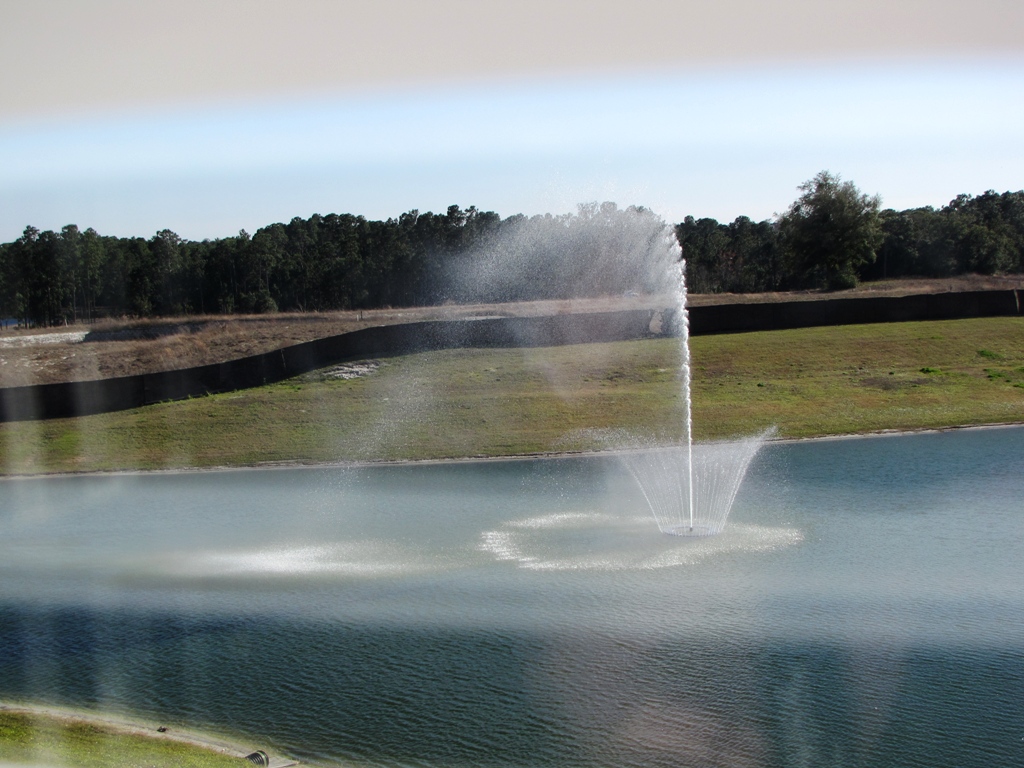
I was standing on the bacony outside my second floor bedroom enjoying the fountain and watching a heron wading around in the pond looking for breakfast.
.
Somebody must have stocked the pantry.
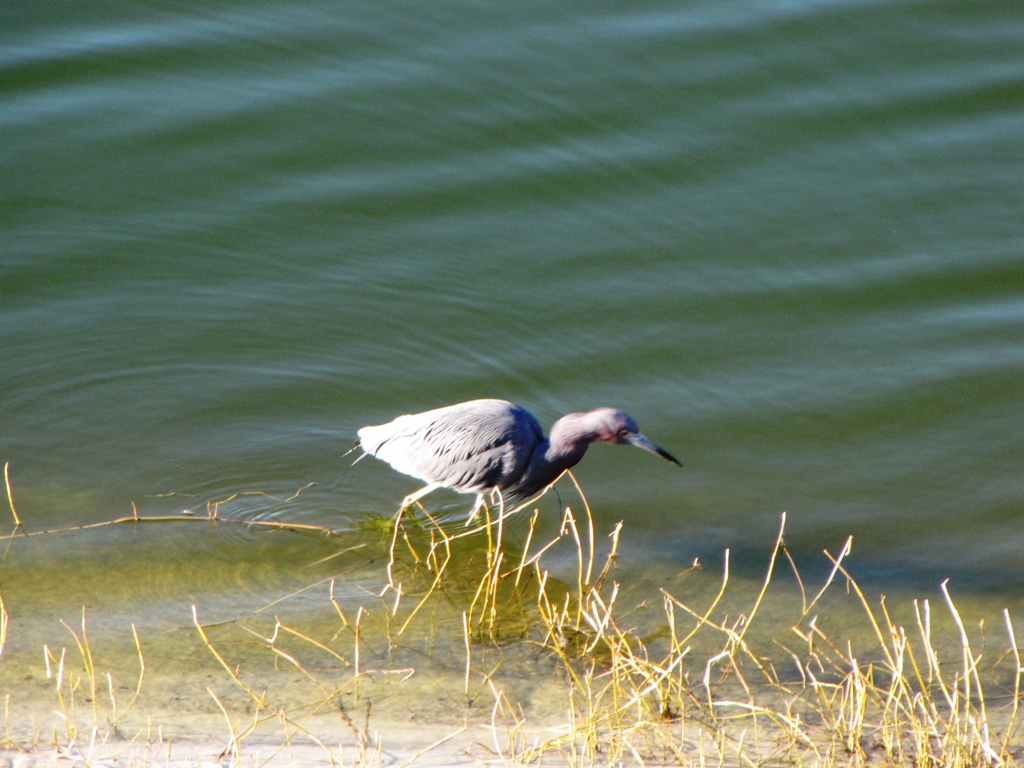
Watching the heron was a nice way to start the day anyway!
Australian Predators of Sheep
In one of the comments on the Dohne Sheep in Australia post, Ceecee asked what other predators bother the sheep at the Homebush farm in Queensland, Australia. I asked Susan about Australian predators of sheep, and her husband was kind enough to send me more information. (Thanks Geoff!)
I’ve added a few extra facts since here in the U.S. we’re not familiar with how these predators became a problem in Australia. So here’s our combined effort, with quotes from Geoff in green:
“Homebush Sheep Predation”
“Feral animals which endanger our sheep are pigs, foxes, and previously domesticated dogs.”
Wild (feral) Pigs –

Feral Pig
Pigs are not a native species to Australia, but were introduced by way of Captain Cook with the first fleet to Australia in 1788.
These days the feral pigs are common and widely distributed over large expanses of Australia. They appear to threaten the long-term survival of a number of species of native plants and animals across Australia by either direct predation of native animals or by consumption of native plants. They also have been implicated in the spread of the root-rot fungus Phytophthora cinnamomi.
And they are a problem when you have sheep!
“Feral pigs are endemic, and hard to control. They are omnivorous, and will eat nearly anything. They are very keen on young lambs. Large specimens have been observed trailing mobs and picking off lamb after lamb from the back of the mob. When killed and cut open they can be seen to have consumed many lambs in one ‘sitting’.”
Foxes –

Fox in Australia (by Joe Tompkins, from the Fox DNA website)
Foxes are feral in Australia because they’re another introduced species. European foxes were brought to Australia in the mid-1800s for hunting. They have spread to most of the continent since that time. Foxes compete with Australian native animals for food and habitat and can act a source of disease. They have a major impact on the Australian fauna, predating on ground nesting birds, mammals and reptiles. . . and sheep!
“Lambs are always at risk from all predators. Healthy adults are generally safe from crows, foxes and pigs. Sick adults or lambing ewes are also at risk from all predators, especially crows and foxes. A lambing ewe is a very vulnerable target. Foxes will kill a lamb before it has cleared the birth canal.”
Feral Dogs –
Wild dogs can be a problem anywhere it seems.
All classes of sheep are in danger of attack from dogs: wild, feral or domestic. A dog, or much worse still, a pack of dogs, can inflict massive damage on a sheep flock. The dogs will kill many in the mob by frenzied biting and tearing, while many other sheep die from being run to exhaustion, and will die with no signs of being bitten. Others will survive the initial attack but develop infection. Unless these sheep are treated with an antibiotic many of them will die, or the wounds become a target for flies to lay their eggs in, which develop into maggots, and this also often leads to death.
Interestingly, after an attack it is possible to determine the type of dog which committed it. A dingo (native dog) will attack the flanks of the sheep, whereas feral or domestic dogs tend to attack the head and fore-parts.
I’ve known of many people here in the states losing sheep to dogs. We’ve even had problems here, but fortunately, there’s never been more dogs at one time than our guard dogs could handle.
Now for the native species of Australian predators!
“Native animals which can attack our sheep are crows, eagles, and dingos.”
Crows –

Crow
Well, crows are familiar here in the US as well, but I don’t think I’ve heard of this problem before. . .
“Crows will attack a ewe in the process of lambing, targeting udder, vulva and eyes. They will attack the lamb during birth or immediately after, before it stands, and peck out the eyes.”
Now that’s nasty!
Eagles –

Wedge Tailed Eagle (courtesy Wikipedia)
These are largest raptors in Australia and are the most common of all the world’s large eagles. Wedge-tails can eat almost anything of a suitable size, live-caught or as carrion, so lambs are right in there as a viable food source.
“Wedge-tailed eagles will target and can carry away lambs, or tear them into carry size portions. They are Australia’s biggest eagle, and a protected species.”
And lastly, one of those uniquely Australian species…
Dingoes –

Dingos, along with feral dogs, are the biggest terrestrial predator in Australia. As such, there are considered an “apex predator”, meaning they have no natural enemies of their own, and sit at the top of the food chain.
The attack sheep pretty much the same way as wild dogs, and are seen as a pest by the sheep industry in Australia.
Geoff also noted. . .
“Health of the sheep is a big factor in their vulnerability to attack from any predator, except dogs. Vitality can be compromised by many factors such as available feed or parasite burden. Nutritional stress simply caused by a reduction in feed quality due to seasonal conditions will impact on the vitality of the sheep enough to make them more vulnerable to attack. Nutritionally depleted ewes have a longer and more difficult lambing, and the ewe and lamb are both slower to recover from the stresses of birth. From their and our point of view a quick birth is a good birth. Our management is highly focused on providing the pre-lambing ewes with added nutrition, especially in adverse seasons, to ensure they as strong as possible for the big event.
Some predation can be rationalized and come to terms with as ‘nature’s way’. When sick, weak, or dying animals are taken for example. However it is hard to accept seeing the remnants of a mob that has been decimated and terrorized by a pack of dogs, or seeing an otherwise perfect lamb dying because it’s eyes were pecked out by a crow as it slept.
But we try.”
Sounds like an exceptionally good shepherd to me! Thanks for all the interesting info Geoff!
[affmage source=”ebay” results=”5″]australia[/affmage]Dohne Sheep In Australia
So what does a little farm in the southern United States have to do with Dohne sheep in Australia?
Well, although we obviously don’t have any Dohne sheep, I have a friend in Australia who does. Ironically, we didn’t meet because we both love sheep, we met because of guinea pigs. Now that’s not because of the pet variety of guinea pigs mind you, but because WE were the guinea pigs. We were in a group of about a dozen people called, yes, The Guinea Pigs! We were testing an internet marketing system. So I’d already discovered Susan was nice before I found out she had sheep, but that’s when I knew she’s REALLY special! 
What’s better, she just sent me some pictures of some of her gorgeous sheep and graciously agreed to let me publish them on my blog.

Dohne Ewe
Doesn’t this ewe have a lovely face? But she’s not just a pretty face! Oh no, this dual purpose breed allows a producer to market both a quality heavy-weight slaughter lamb and fine-medium white wool.
Oh, and in case you’re like me and wondering just how to pronounce Dohne, Susan says it’s pronounced ‘do knee’.
Check out this picture of the flock last October, during lambing season.

Dohne Sheep
Another irony there, as October was when we used to breed our Shetland ewes, but since their seasons in Australia are reversed from ours in the States, so are the times for breeding and lambing.
And here’s one of the Dohne lambs. . .

Dohne Lamb from Australia
And as cute as this little lamb is, I think this picture is even cuter. . .
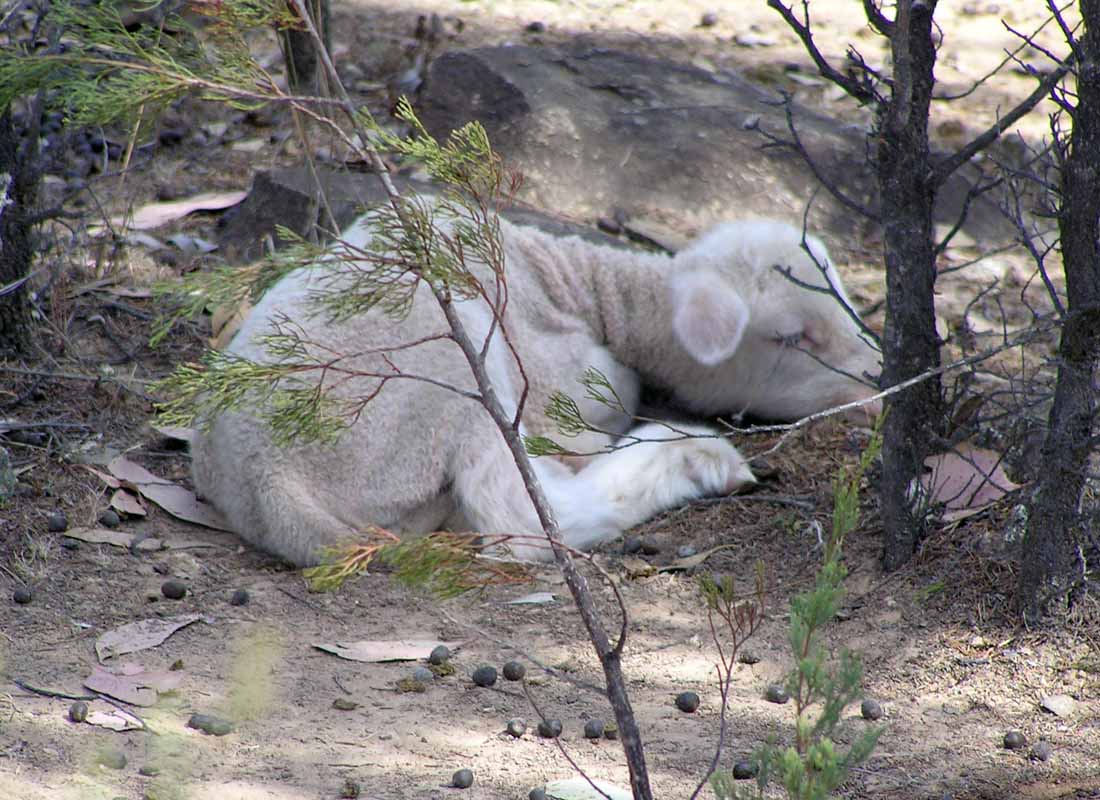
Sleeping Dohne Lamb at Homebush in Australia
Isn’t that precious? Come on now, you know it is!
In case you’re not familiar with the Dohne breed, the Australian Dohne Breeders Association says they were
“developed by the South African Department of Agriculture using Peppin–type Merino ewes and German Mutton Merino sires. The progeny were interbred and selected for high fertility, rapid lamb growth rate and fine wool under commercial pastoral conditions.”
So not only are they a robust meat breed, they have that lovely Merino wool. Susan says, “Our wool is still around the 18.5 micron, so we lose nothing in wool quality! It is soft and beautiful.”
Looking after these sheep has to be a big project considering the size of Homebush. Our little 12-acre farm is only about 1/3 of 1% the size of their place. Or to put it another way, our farm is 1/259th the size of Homebush. Quick! So how big is their place???

Mustering a flock of Dohne Ewes in Australia.
If you said 3108, you calculated correctly, but the precise number is actually 3110 acres. (It was too hard to put fiddly teensy fractions in there!)
That’s a lot of land to go looking for sheep! Looks like they have canine assistance to bring in the lambs though.

Mustering Dohne Lambs at Homebush in Australia.
The lambs in the above picture are only 2 – 3 months old. They grow quick!
I asked Susan how many sheep and other livestock they have, and here’s the count she gave me for creatures at Homebush:
- 1000 Dohne sheep
- 100 Brangus Cows with calves
- 2 Horses
- 5 Dogs
- 3 Cats
- 15 Chickens
- 1 Corella (native to Australia; also called a Bare-eyed Cockatoo)
- And hundreds of kangaroos that eat our precious grass!!
- Plus plenty of wild pigs that eat our lambs, and
- Eagles that steal lambs, not to mention
- Crows that try to kill lambs and ewes . . .
- ….and that’s about it, except for us three humans, my mum, my husband and me
All I can say is…. Wow! And with that, it’s time for the end. . .

Mustering Dohne Lambs
Or maybe a whole lot of ends!
Thanks Susan for sharing your pictures and fun info about your Dohne sheep and other critters at Homebush farm in Queensland, Australia!