Antique Farm Equipment At Falls Mill Museum
The Farmer loves looking at old farm equipment. I think it reminds him of the good old days, back when he was a kid on a farm in Oklahoma.
Take all this antique farm equipment we saw at Falls Mill Water-Powered Grain Mill And Museum in Belvidere, Tennessee:

Old Farm Equipment
The Farmer informed me that one of these is an old horse-drawn riding cultivator, and that they used to have one on the farm where he grew up. The piece of old farm equipment to the left of it is a two-row planter, and was also pulled by horses.
In the back of that first picture there’s an antique manure spreader. Here it is from the business end:

Antique Manure Spreader
I suppose I shouldn’t admit to this, but I remember having something like this on the farm when I was growing up! Only by then, it was pulled by a tractor instead of horses. My folks would take a load of cow manure out of the barnyard, pull this manure spreader and let the errr… manure… fly over the pastures. I’m sure it was great for fertilizing the fields, but it sure did stir up a stink for a while! (Bet the neighbors loved it, don’t you?)
There was also an old Ford truck at Falls Mill Museum:

Old Ford Truck
This 1946 Ford truck was used for over 40 years to haul grain to the Little Red Mill in Winchester, Tennessee. It was also used at Falls Mill.
The sign on the old Ford truck says they are hoping to restore it some day.
Me, I’d rather see the old horse drawn riding cultivator, say behind a Belgian or Clydesdale or Percheron horse. Yeah, that’d be cool. I just LOVE those big draft horses!
.
[affmage source=”ebay” results=”5″]antique farm equipment[/affmage] [affmage source=”amazon” results=”2″]antique farm equipment[/affmage]Autumn Azalea And Wooly Bears
This weekend I noticed that not only is the camellia bush hanging in there and blooming, but the Autumn Azalea bushes in the same flower bed have decided to have a last hurrah and throw out a few blooms. I guess they decided to live up to their name, since they are from the Encore® Azalea Collection.
This first one is an Autumn Debutante Azalea.

It’s a light pink, whereas the other one, Autumn Sangria Azalea, is a hot pink.

Having checked those out, Toby and I decided to go for a walk in the woods. We passed The Farmer in the bottom pasture.

He was busy burning old feed sacks and boxes. I don’t know how we seem to accumulate so many boxes, but there always seem to be a bunch around here.
There was a nice bright yellow leaf caught in the weeds.

Some day I need to figure out what kind of tree has that leaf. We have a lot of them around here, whatever they are.
Right beside the path going into the woods there is an old tree that’s been stuck by lightning. At the base of the tree some fungus balls were growing.

I haven’t seen any quite like them before. There’s nothing in the picture to give you a perspective, but they’re all about 1 inch across or less.
Of course we can’t go back in the woods without taking a stroll along the creek. It’s got lot of leaves floating on it.

They especially collect along the sides, or around obstacles like this fallen tree.
I don’t know about other American Working Farmcollies, but our Toby LOVES water. The highlight of a run in the woods is to splash across the creek and back at least once.

Given the opportunity, it’s more like 2 or 3 or … more times.
On our way back to the house, I stopped and turned over one of the salt bins. This is the same one I found a black widow spider under earlier this summer. Thankfully, this time it was a more innocuous discovery.

Whether you call it a wooly bear, wooly worm, or more properly, the banded woolly bear, we find a lot of them around here. They hatch late in the summer or fall, and overwinter in this caterpillar form. What’s cool is that the little wooly worms survive freezing by producing a cryoprotectant in their body. How about that, this cool little woolly bear produces its own antifreeze!
Next spring, the little wooly worm will eat and eat, snarfing down all the grass and weeds it can. Then it pupates, and the fuzzy little wooly bear turns into the Isabella tiger moth:

Of course, while it’s still a fuzzy little wooly bear, you’re supposed to be able to use the banded woolly bear to predict what kind of winter is on the way. Supposedly, the thinner the brownish red bands, the harsher the winter will be. So if the wooly worm is mostly brownish red in the middle, winter will be mild.
Considering how wide the brownish red band was on the wooly bear I found, looks like if the folklore is correct, we ought to have a mild winter!
Lumberjack On The Farm
One of the trees near the house died. Our lumberjack on the farm was tired of looking at the dead limbs, so decided he’d do something about it this weekend and play tree surgeon.
The problem was the tree’s location. It’s near a pole with a transformer, electric lines, the house, and several fences. So The Farmer devised a plan to get the tree limb to fall in the one direction it could safely go.
First he climbed up in the tree and tied a rope around the offending limb, then he took that rope and hooked it to another rope with a winch on one end, and that rope anchor-tied to a big walnut tree in the back yard.

Once that was done, he climbed up in the tree.

Then he was ready to start sawing on the tree limb.

He went up and down two or three times, but the limb was stubborn. It didn’t want to crack loose and fall down away from the tree. (I think it is safe to say The Farmer does NOT have a master’s degree in aboriculture.)
Finally he sawed through enough of the wood that it DID work.
“Did you get that?”
Of course, it didn’t fall *exactly* where it should have, and part of it crashed down on the pallet fence. But at least none of it fell on our Lumberjack.
You can see the limb was pretty high up in the tree
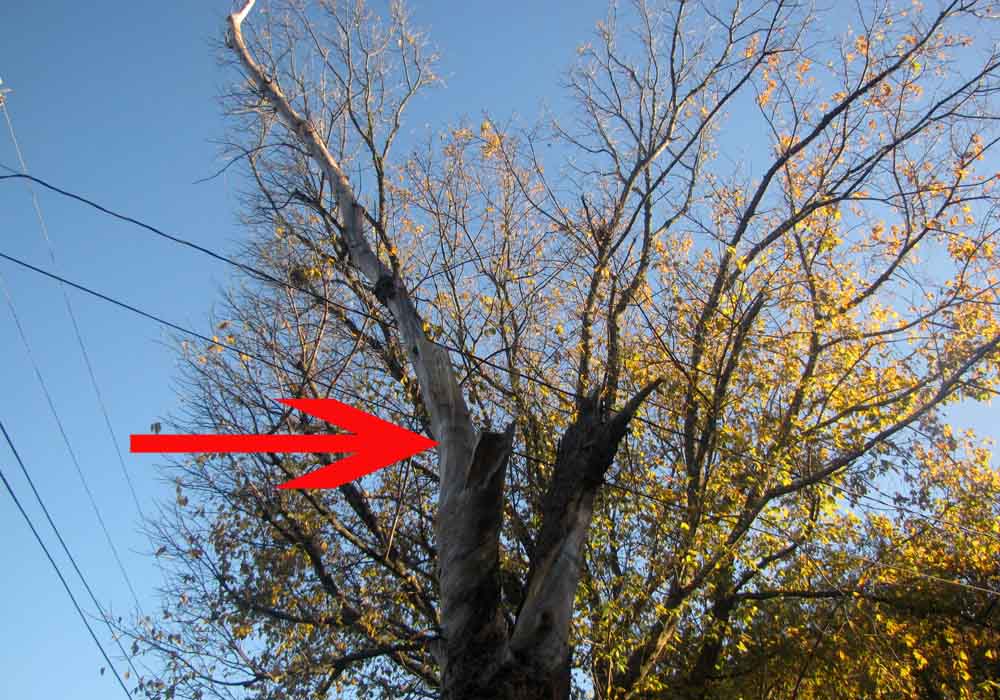
Here’s a close-up of where the limb finally broke totally off:

Now there’s a mess of tree limbs on the ground to clean up:

Our lumberjack on the farm, aka tree surgeon, aka arboriculturalist, is still eyeballing the remaining dead tree limbs with thoughts of yet more removals. I shudder to think where the next one might land, as it is even closer to the electric wires.
Is there a tree surgeon in the house?
Just Coolin’ It.
It’s been up in the 90’s here lately, and when you’re covered in black fur that means it feels REALLY hot! So our farm collie, Toby, is always looking for the nearest patch of shade (between bouts of frenetic activity – liking chasing squirrels, or zipping through a pack of guineas so he can watch them fly, or … you get the idea).

We’ve got lots of huge walnut and oak trees in the back yard, so all the animals like to congregate there.
The notable exception to this shade seeking is the sun seeking turtles who seem to thrive on sunning themselves.

They have a new log to float on as the first eventually sank, presumably because the dead wood became… well, water-logged!
Around here the critters are either soaking up the sun or have it made in the shade, but they all seem to be enjoying summer.
Cluttered Culverts
Whenever there’s a heavy rain, our bottom pasture floods because the creek gets out of bounds. It probably wouldn’t do it so much if it weren’t for the fact the creek goes under a road right past our bottom pasture.
There are two culverts under that road, and they collect debris. After the last hard rain, I decided to go down and take a peek. The neighbors living past the bridge have a pack of dogs. Three of them watched me approach.

Toby as usual, totally ignored them. He seems to think they are beneath his notice, and he doesn’t even bother looking at them, let alone barking at them.
Once we got on the bridge, I looked down the creek flowing alongside our bottom pasture.

It had been a while since it rained, so the water was almost totally clear again. I walked past the bridge and went down alongside the creek to see what kind of debris was clogging up the culverts upstream.

It doesn’t look too bad until you look a little closer. Here’s a close-up of the culvert on the left:

And here’s a close-up of the culvert on the right:

After seeing what kind of debris was clogging up the culvert upstream, I went to the other side to see what it looked like from the downstream side, which is the part bordering our bottom pasture.

From a ways off, it really doesn’t look like there’s much of a problem, does it? But when I got down to where I could take pictures a little closer-up, you can see how the water flow is restricted.
Here’s the culvert that had the single log across it on the upstream side:

As you can see, it was a bit deceiving seeing just that one log across the mouth of the culvert on the other side. There’s a whole lot more debris underneath it that is also blocking the flow of water.
I couldn’t get a straight-through shot of the other culvert, but you can see it has some pretty big tree parts in it!

It’s no wonder when the rain is heavy, the stream overflows because the culverts are blocked, and goes over the top of the road.

And of course, when the creek backs up and floods over the road, it also backs up into our bottom pasture:

We have electric fencing around that pasture, and every time it floods, it needs repaired. However, since we’ve downsized and don’t have so many animals, we don’t have to worry about it because we’re not using it for grazing space.
Instead, we’re letting it grow up wild again. When we first moved here, there were all kinds of wildflowers like Joe Pye Weed and Cardinal Flower in that area, along with Button Bushes and other good habitat for wildlife.
Hopefully, there will be lots of flowers grow there this summer, and we’ll see lots of butterflies!